| Warren Commission | Media Library | Articles | FAQ | Links | Feedback | Contact | About |
 |
The John F. Kennedy Assassination Homepage |  |
IntroductoryFeatured ArticlesReferences |
The Assassination: An OverviewDuring his electoral battle tour in the south of the States, John F. Kennedy visited Dallas (Texas) on November 22, 1963. On his arrival at 1140 hours, he was warmly welcomed by the people of Dallas. Kennedy, Governor John Connally and their wives sat down in the limousine of the President which led the motorcade through the town.
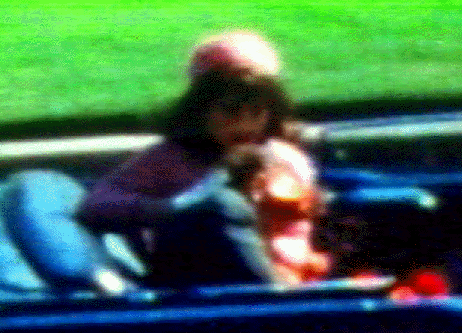 Zapruder frame 335: The fatal head shot Just when the limousine passed the Stemmons Freeway sign, Mrs. Connally heard a kind of gunshots. When she turned looking at the President, she saw him taking his hand to his throat covering a shooting wound. The next second Governor Connally felt an ache in his back which he recognized as a shot. He later said:
The reaction of the Secret Service Agents was quite slow. The most of them spent the evening before in "The Cellar" bar that was owned by an acquaintance of Jack Ruby. 45 minutes later, Lee Harvey Oswald was arrested in charge of murder to police officer J.D. Tippit. After hours of interrogation where no lawyer was present and no protocol was made, Oswald was accused of murder to John F. Kennedy. On November 24, 1963, a Sunday morning, he was supposed to be handed over to the State Prison. In the garage of the police building, he was shot by Jack Ruby in front of hundreds of journalists and millions of TV watchers. The Warren Commission - constituted one week later - declared after months of investigation:
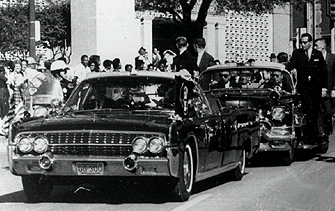 The moment when the first bullet struck
The third wounded man doesn't fit into the version of the Warren Commission, too: James Tague. He stood near the Triple Underpass ahead of the motorcade and was wounded by a passing bullet. Because the first shot wounded Kennedy's throat, the second Connally's back, and the third was the headshot, there must had been a fourth shot. This made the Warren Commission changing their version and creating the "Magic Bullet" theory. This bullet was supposed to cause the seven wounds of Kennedy and Conally. This Commission Exhibit #399 was found later in an almost pristine condition(!) at Parkland Memorial. One of the most known evidences is the film which Abraham Zapruder took directly next from the Grassy Knoll that day. It shows the assassination in full length. There, one can also see the opened umbrella of the Umbrella Man despite the shining sun and cloudless sky. More photos show two suspicious men behind the fence at the Grassy Knoll - one with a rifle - who have been called "Black Dog Man" and "Badge Man" because of the unknown identity. The Warren Commission never mentioned these men and never made any effort to find them. In the three-year period which followed the murders of President Kennedy and Lee Harvey Oswald, 18 material witnesses died - six by gunfire, three in motor accidents, two by suicide, one from a cut throat, one from a karate chop to the neck, three from heart attacks and two from natural causes. In the late 1970s, the House Select Committee on Assassinations felt compelled to look into the matter. The Committee was unable to come to any conclusion regarding the growing number of deaths. However, an objective look at both the number and the causes of death balanced against the importance of the person's connection to the case, raises concern. |
Found a Typo?Click herePartner Links
|


| Copyright by www.jfk-assassination.com | Last Update: Wed, 3 Aug 2016 23:56:31 CET |